















The 48-Team Format: Blessing or Curse for the Group Stage?
The FIFA World Cup 2026 is about to take over North America, and it’s not just the first time three countries are hosting. This one’s going down as the tournament that really shook up football’s biggest show. With the jump from 32 to 48 teams, FIFA’s talking up global inclusion and a packed schedule. Still, if you’ve followed the World Cup for years, you’re probably wondering-does making it bigger actually make it better? Especially when it comes to that nail-biting tension we all love in the Group Stage.
The End of a Golden Era: Farewell to the Four-Team Group
For decades, the format was simple, brutal, and perfect: 32 teams divided into eight groups of four. Two teams survived. The equation was clear, and the tension was immense. The final matchday in groups like the 2014 "Group of Death" often produced simultaneous, heart-stopping drama where a single goal could flip the fortunes of four nations.
The 48-team tournament, however, introduces a completely new structure: 12 groups of four teams (12x4).
Key Changes Under the New Structure:
- Total Matches: Jumps from 64 to 104.
- Finalists: Increases by 16 teams.
- The Crucial Third-Place Finish: The top eight third-placed teams will now advance to the Round of 32.
This last point is the game-changer, and it fundamentally alters the Group Stage mentality.
The Case for the 'Blessing': Inclusion and Financial Power
FIFA’s argument for expansion is rooted in two pillars: global development and raw economics.
Arguments for Expansion (The Blessing):
- True Global Representation: The expansion offers unprecedented opportunities for nations in Africa (nine spots), Asia (eight spots), and CONCACAF (six spots, including hosts). For countries like Vietnam, Burkina Faso, or Ecuador (who might struggle under the 32-team format), qualification is now a realistic dream. This is crucial for growing the game.
- New Rivalries, New Stories: More teams mean fresh matchups. Imagine the excitement of a new underdog like Iceland in 2016, but multiplied. These new stories bring different styles of football and unpredictable results, which is ultimately what the World Cup thrives on.
- The Financial Juggernaut: This is undeniable. More games mean vastly increased revenue from broadcasting rights, sponsorships, and ticket sales. For FIFA, the 48-team format is a financial goldmine, and a portion of that money theoretically fuels football development worldwide.
The 'Curse' of Dilution: The Death of Group Stage Drama
Critics argue that by making qualification easier and allowing eight third-placed teams to proceed, the core tension and knockout pressure of the Group Stage will be significantly diluted.
Why the Thrill May Fade (The Curse):
- Safety Net for Underperformance: When third place often leads to advancement, teams have a much larger safety net. A powerhouse might stumble in their first two games but still qualify, simply by beating a weaker fourth seed. Where is the high-stakes risk that defined past tournaments?
- The Drop in Quality: Logically, adding 16 teams means lowering the barrier to entry. While this promotes inclusion, it could lead to more lopsided scorelines in the initial games. No one wants to see a 7-0 blowout; the magic of the Group Stage was its consistently competitive edge.
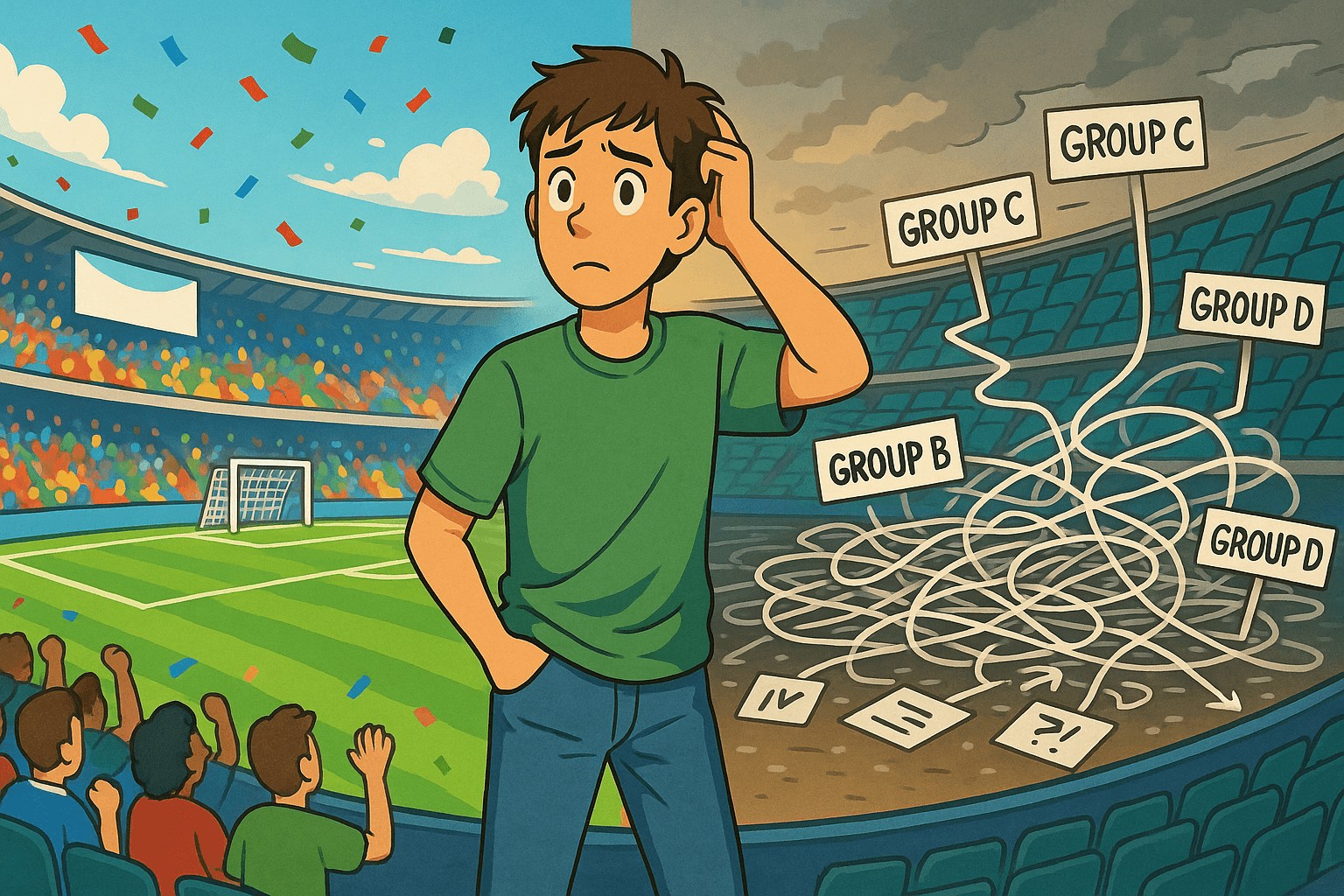
- The Final Day Confusion: The complexity of comparing eight third-placed teams from twelve groups introduces an element of uncertainty and potential anticlimax. Instead of two clear simultaneous matches deciding the group, fans may have to wait for hours-or even a full day-while other groups finish, leaving several teams in purgatory. The simplicity of the old format is lost.
The Crucial Balancing Act: Will the Round of 32 Save the Day?
Perhaps the true genius (or flaw) of the 48-team expansion lies not in the Group Stage, but in what immediately follows it: the new Round of 32.
The elimination matches will now begin a stage earlier, featuring 16 extra teams. This means the immediate consequences of a loss are reintroduced more quickly.
“The tournament will trade the sharp, instant drama of the 32-team Group Stage for a protracted, intense knockout phase. The real tournament effectively begins earlier, just less cleanly.”
While the Group Stage might feel more like a sorting hat, once those 32 teams are locked, the knockout phase will be longer and more exhausting, demanding immense squad depth from the eventual winner. The pressure will be relentless from the very first elimination match.
The Verdict: A Necessary Compromise?
Is the new format a blessing or a curse? In the immediate sense, it is likely a curse for the purity and dramatic simplicity of the traditional Group Stage. We are losing the clear-cut, all-or-nothing jeopardy that defined the first two weeks of the competition.
However, the expansion represents a necessary compromise for the sport's global future. It is a massive blessing for development and global representation, injecting excitement and vital funds into regions that desperately need them.
The 2026 World Cup is going to feel huge. This time, the pressure won’t hit right away in the Group Stage-it’s going to pick up later, when the knockout rounds stretch on and on. Fans should get ready for a new kind of drama. Instead of quick bursts of excitement, the tension will simmer, building up slowly. The tournament will last longer, it might wear everyone out a bit more, but in the end, it’ll pull in more teams and fans than ever.

![[object Object] thumbnail](/_next/image?url=https%3A%2F%2Ftdilgfvkfgobczkxybzs.supabase.co%2Fstorage%2Fv1%2Fobject%2Fpublic%2Fthumbnails%2Fusameexicocandafight.png&w=1080&q=75)
![[object Object] thumbnail](/_next/image?url=https%3A%2F%2Ftdilgfvkfgobczkxybzs.supabase.co%2Fstorage%2Fv1%2Fobject%2Fpublic%2Fthumbnails%2Farticle-681a0894-ad2c-4159-930a-0871c7ee6331%2FSpain_World_Cup_Winners_Argentina_v_Spain_19_July_2026-1.jpg&w=1080&q=75)
![[object Object] thumbnail](/_next/image?url=https%3A%2F%2Ftdilgfvkfgobczkxybzs.supabase.co%2Fstorage%2Fv1%2Fobject%2Fpublic%2Fthumbnails%2Fwc2026prestige.png&w=1080&q=75)